Exh: 1998/03

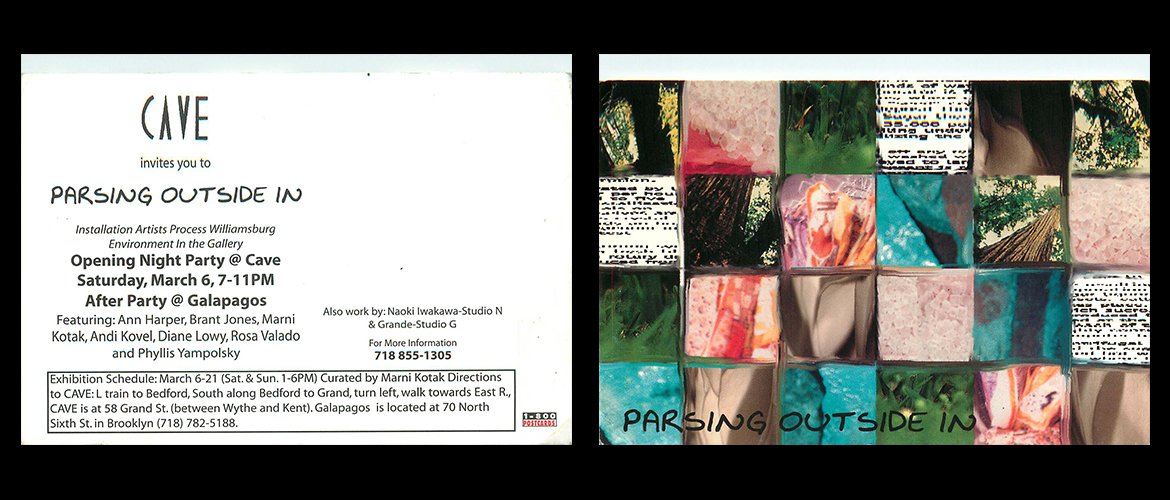
PARSING OUTSIDE IN

March 7 – 29, 1998
Parsing Outside in
Curated by Marni Kotack

Installation Artists Process Williamsburg Environments in the Gallery
Ann Harper, Brant Jones, Marni Kotak, Andi Kovell, Diane Lowy, Rosa Valado, Phyllis Yamposky

Additional Works

Studio G:
Garden
Installation by Grande with Kengo Hioki

Studio N:
N
Installation by Naoki Iwakawa Sound by Nao Sakamoto

Links


>Video Documentation

About

From 1996-2006, the gallery at CAVE showed the work of over 300 artists becoming a locus for experimentation in all mediums. CAVE Gallery began as a venture of Shige Moriya and a group of artists in the mid-90’s. Fostered from an industrial rental, they transformed the 3,000 sq ft garage into a live-work space, which was considered to be one of the first recognized galleries of the neighborhood. Away from heavy commercial pressure, in an environment that supported exploration, artists were able to present ‘nakedly’ by offering completed and in-progress works and receiving feedback from peers. In addition to studio arts, openings often included music and other kinds of performances.

Exh: 1998/03

PARSING OUTSIDE IN

March 7 – 29, 1998
Parsing Outside in
Curated by Marni Kotack

Installation Artists Process Williamsburg Environments in the Gallery
Ann Harper, Brant Jones, Marni Kotak, Andi Kovell, Diane Lowy, Rosa Valado, Phyllis Yamposky

Additional Works

Studio G:
Garden
Installation by Grande with Kengo Hioki

Studio N:
N
Installation by Naoki Iwakawa Sound by Nao Sakamoto

Links


>Video Documentation

About

From 1996-2006, the gallery at CAVE showed the work of over 300 artists becoming a locus for experimentation in all mediums. CAVE Gallery began as a venture of Shige Moriya and a group of artists in the mid-90’s. Fostered from an industrial rental, they transformed the 3,000 sq ft garage into a live-work space, which was considered to be one of the first recognized galleries of the neighborhood. Away from heavy commercial pressure, in an environment that supported exploration, artists were able to present ‘nakedly’ by offering completed and in-progress works and receiving feedback from peers. In addition to studio arts, openings often included music and other kinds of performances.

Exh: 1997/12

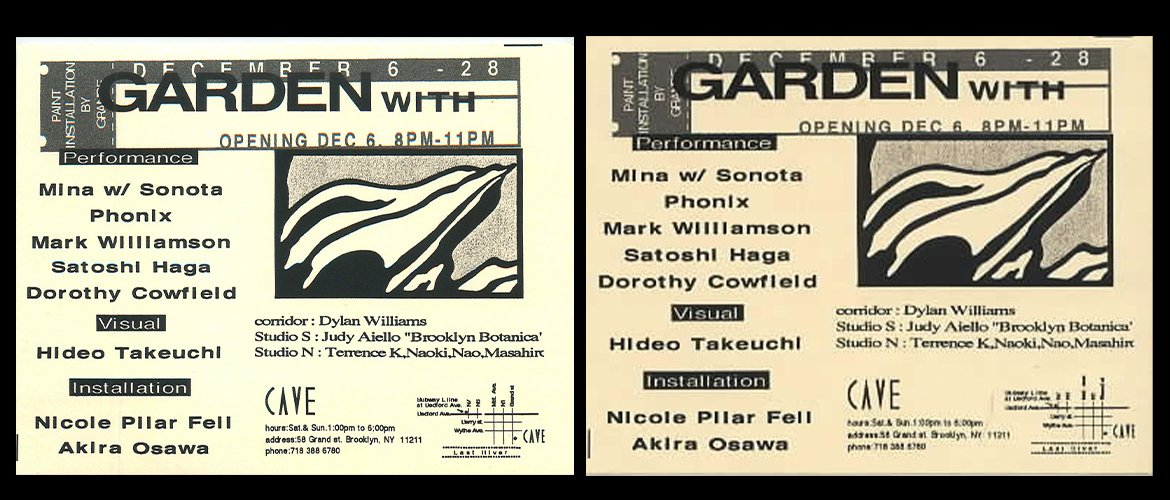
GARDEN

December 6 – 28, 1997
Garden
Installation by Grande
Visual by Hideo Takeuchi

Opening Performances

Mina with Sonota
Phonix
Mark Williamson
Satoshi Haga
Dorothy Cowfield

Additional Works

Studio S:
Brooklyn Botanica
by Judy Aiello

Studio G:
Nicole Pilar Fell & Akira Osawa

Studio N:
N
Installation by Naoki Iwakawa Sound by Nao Sakamoto
Film projection by Masahiro Manabe

Links


>Exhibition Images

>Opening Event Images

>Video Documentation

About

From 1996-2006, the gallery at CAVE showed the work of over 300 artists becoming a locus for experimentation in all mediums. CAVE Gallery began as a venture of Shige Moriya and a group of artists in the mid-90’s. Fostered from an industrial rental, they transformed the 3,000 sq ft garage into a live-work space, which was considered to be one of the first recognized galleries of the neighborhood. Away from heavy commercial pressure, in an environment that supported exploration, artists were able to present ‘nakedly’ by offering completed and in-progress works and receiving feedback from peers. In addition to studio arts, openings often included music and other kinds of performances.

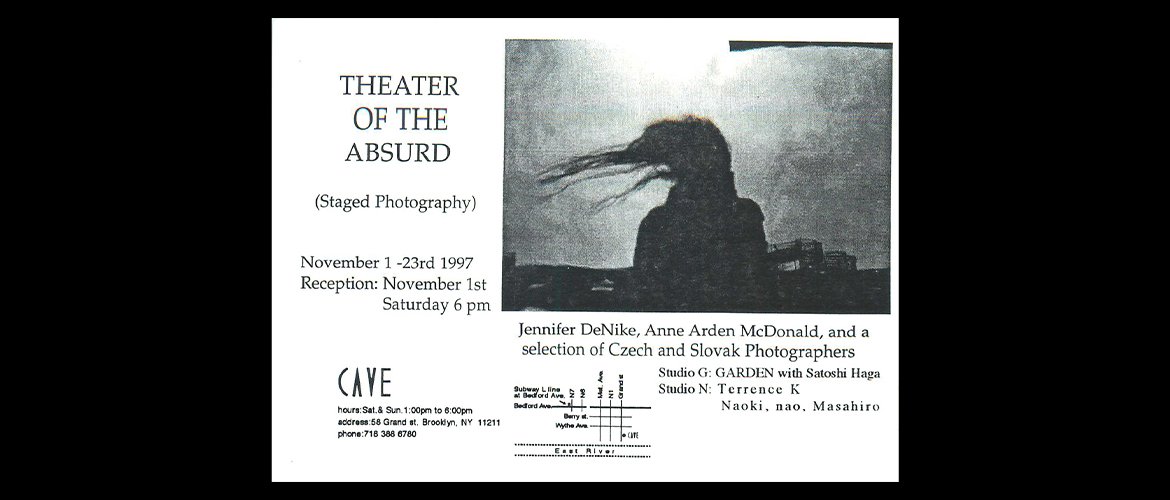
Exh: 1997/11

THE THEATER OF THE ABSURD

November 1 – 23, 1997
The Theater of the Absurd

Staged Photography
Jennifer DeNike
Ann Aeden McDonald
Selections of Czech and Slovak Photographers
Curated by Ann Aeden McDonald

Additional Works

Studio G:
Garden
Installation by Grande with Satoshi Haga

Studio N:
Episode-8
Installation by Naoki Iwakawa Performance by Terrence Kellman Sound by Nao Sakamoto
Film projection by Masahiro Manabe

Links


>Exhibition Images

>Opening Event Images

>Video Documentation

About

From 1996-2006, the gallery at CAVE showed the work of over 300 artists becoming a locus for experimentation in all mediums. CAVE Gallery began as a venture of Shige Moriya and a group of artists in the mid-90’s. Fostered from an industrial rental, they transformed the 3,000 sq ft garage into a live-work space, which was considered to be one of the first recognized galleries of the neighborhood. Away from heavy commercial pressure, in an environment that supported exploration, artists were able to present ‘nakedly’ by offering completed and in-progress works and receiving feedback from peers. In addition to studio arts, openings often included music and other kinds of performances.

Exh: 1997/09

TOTAL ECLIPSE

September 13 – October 5, 1997
Total Eclipse
Paintings by Naoki Iwakawa

Opening Performances

Tanya Kane – Parry with Evren Celimli
Yuki Takeuchi with Betty Fukuhara
Terrence Kellman

Additional Works

Studio S:
Sculpture by Kenta Furusho

Studio G:
Garden
Installation by Grande with Kengo Hioki

Studio N:
N
Installation by Naoki Iwakawa Sound by Nao Sakamoto
Film projection by Masahiro Manabe

Links


>Exhibition Images

>Video Documentation

About

From 1996-2006, the gallery at CAVE showed the work of over 300 artists becoming a locus for experimentation in all mediums. CAVE Gallery began as a venture of Shige Moriya and a group of artists in the mid-90’s. Fostered from an industrial rental, they transformed the 3,000 sq ft garage into a live-work space, which was considered to be one of the first recognized galleries of the neighborhood. Away from heavy commercial pressure, in an environment that supported exploration, artists were able to present ‘nakedly’ by offering completed and in-progress works and receiving feedback from peers. In addition to studio arts, openings often included music and other kinds of performances.

Exh: 1997/06

WOOD WORLD

June 28 – July 27, 1997
Wood World
Sculpture by Hisayasu Takashio

Opening Performances

Mutant by Hisayasu Takashio
Into the Shadow by Mina

Additional Works

Studio S:
Panda Room
Installation by Kengo Hioki

Studio G:
Anarchitects
Paintings by Grande

Studio N:
Episode 5
Installation by Naoki Iwakawa
Sound by Nao Sakamoto
Film projection by Masahiro Manabe

Links


>Exhibition Images

>Opening Event Images

>Video Documentation

About

From 1996-2006, the gallery at CAVE showed the work of over 300 artists becoming a locus for experimentation in all mediums. CAVE Gallery began as a venture of Shige Moriya and a group of artists in the mid-90’s. Fostered from an industrial rental, they transformed the 3,000 sq ft garage into a live-work space, which was considered to be one of the first recognized galleries of the neighborhood. Away from heavy commercial pressure, in an environment that supported exploration, artists were able to present ‘nakedly’ by offering completed and in-progress works and receiving feedback from peers. In addition to studio arts, openings often included music and other kinds of performances.

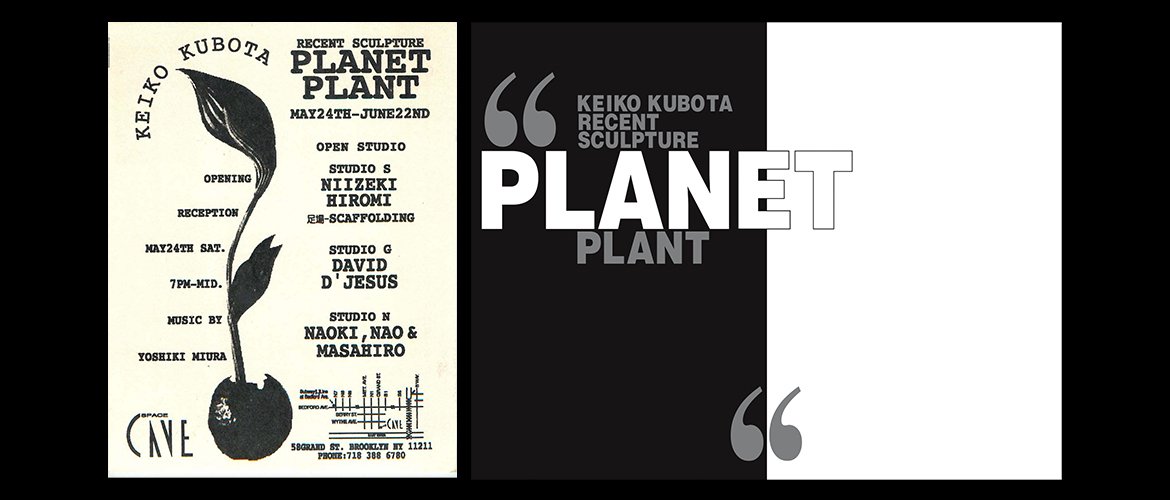
Exh: 1997/05

PLANET PLANT

May 24 – June 22, 1997
Planet Plant
Sculpture by Keiko Kubota

Opening Performance

Music by Yoshiki Miura

Additional Works

Studio S:
Scaffolding
Installation by Hiromi Niizeki

Studio G:
Untitled
Painting by David D’Jesus

Studio N:
Episode 5
Installation by Naoki Iwakawa Sound by Nao Sakamoto
Film projection by Masahiro Manabe

Links


>Exhibition Images

>Video Documentation

About

From 1996-2006, the gallery at CAVE showed the work of over 300 artists becoming a locus for experimentation in all mediums. CAVE Gallery began as a venture of Shige Moriya and a group of artists in the mid-90’s. Fostered from an industrial rental, they transformed the 3,000 sq ft garage into a live-work space, which was considered to be one of the first recognized galleries of the neighborhood. Away from heavy commercial pressure, in an environment that supported exploration, artists were able to present ‘nakedly’ by offering completed and in-progress works and receiving feedback from peers. In addition to studio arts, openings often included music and other kinds of performances.

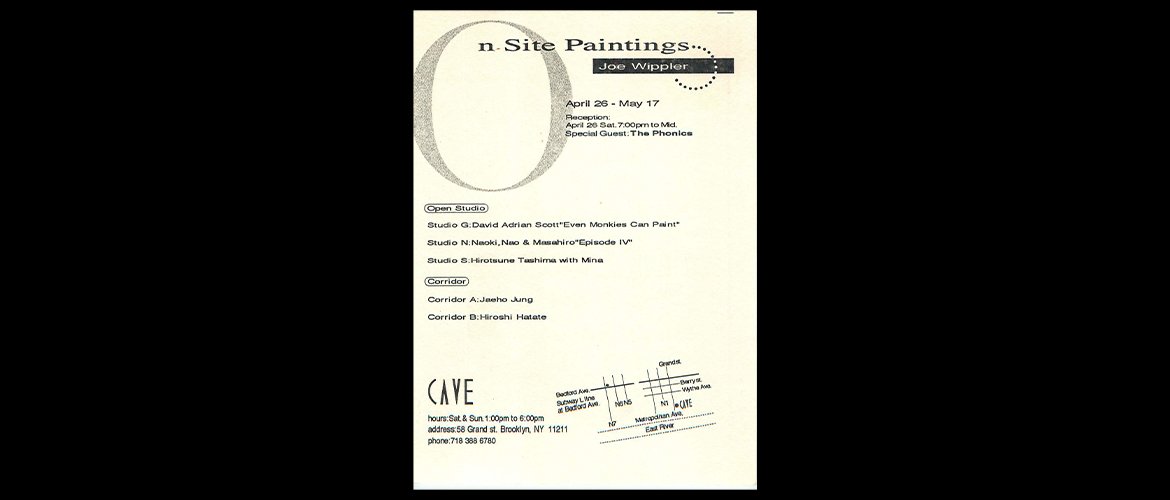
Exh: 1997/04

ON SITE PAINTINGS

April 26 – May 17, 1997
On Site Paintings

Installation by Joe Wippler

Opening Performance

Phonix

Action Painting by Naoki Iwakawa

Additional Works

Studio G:
Even Monkies Can Paint
Paintings by David Adrian

Studio N:
Episode 4
Installation by Naoki Iwakawa
Sound by Nao Sakamoto
Film projection by Masahiro Manabe

Studio S:
Ceramic sculpture by Hirotune Tashima

Links

>Opening Event Images

>Video Documentation

About

From 1996-2006, the gallery at CAVE showed the work of over 300 artists becoming a locus for experimentation in all mediums. CAVE Gallery began as a venture of Shige Moriya and a group of artists in the mid-90’s. Fostered from an industrial rental, they transformed the 3,000 sq ft garage into a live-work space, which was considered to be one of the first recognized galleries of the neighborhood. Away from heavy commercial pressure, in an environment that supported exploration, artists were able to present ‘nakedly’ by offering completed and in-progress works and receiving feedback from peers. In addition to studio arts, openings often included music and other kinds of performances.

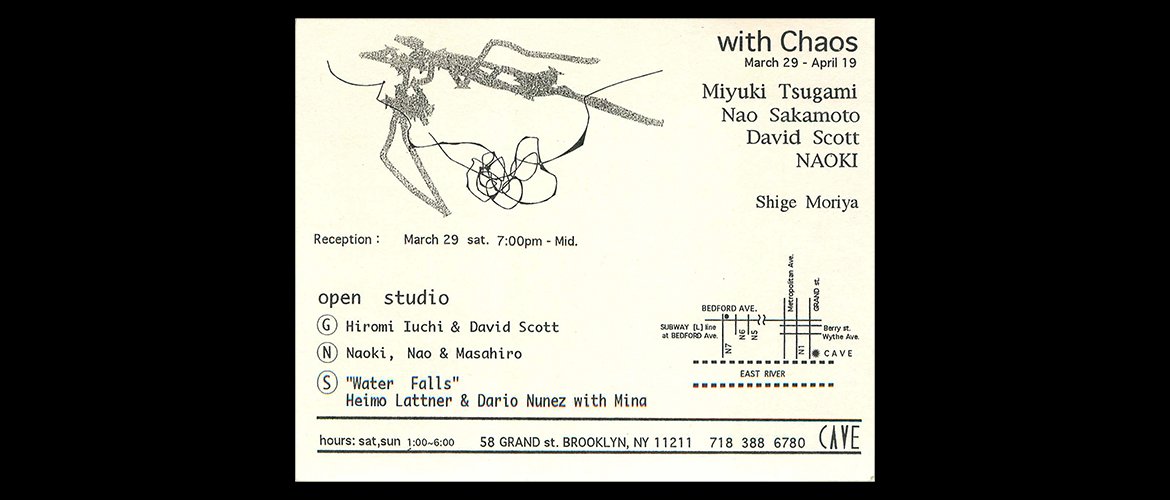
Exh: 1997/03

WITH CHAOS

March 29 – April 19, 1997
With Chaos
Direction by Shige Moriya
Wall paintings by Miyuki Tsugami

Opening Performances

Sound organized by Nao Sakamoto
Music by David Scott

Action Painting by Naoki Iwakawa

Additional Works

Studio G:
Hiromi Iuchi & David Scott

Studio N:
Episode 3
Installation by Naoki Iwakawa Sound by Nao Sakamoto
Film projection by Masahiro Manabe

Studio S:
Water Falls
Slides & sound installation by Heimo Lattner & Dario Nunez
Dance by Mina

Links

>Opening Event Images

>Video Documentation

About

From 1996-2006, the gallery at CAVE showed the work of over 300 artists becoming a locus for experimentation in all mediums. CAVE Gallery began as a venture of Shige Moriya and a group of artists in the mid-90’s. Fostered from an industrial rental, they transformed the 3,000 sq ft garage into a live-work space, which was considered to be one of the first recognized galleries of the neighborhood. Away from heavy commercial pressure, in an environment that supported exploration, artists were able to present ‘nakedly’ by offering completed and in-progress works and receiving feedback from peers. In addition to studio arts, openings often included music and other kinds of performances.

Exh: 1996/12

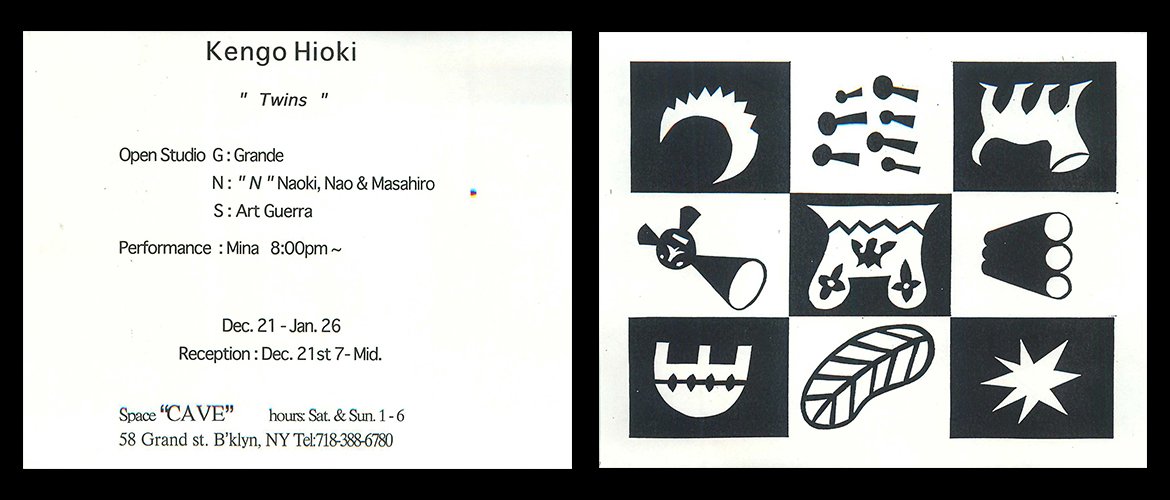
TWINS

December 21 – January 26, 1996
Twins

by Kengo Hioki

Opening night music performance

Mina

Additional Works

Studio G:
Grande

Studio N:
N
Paintings by Naoki Iwakawa
Sound by Nao Sakamoto
Film projection by Masahiro Manabe

Studio S:
Paintings by Art Guerra

Links


>Exhibition Images

>Video Documentation

About

From 1996-2006, the gallery at CAVE showed the work of over 300 artists becoming a locus for experimentation in all mediums. CAVE Gallery began as a venture of Shige Moriya and a group of artists in the mid-90’s. Fostered from an industrial rental, they transformed the 3,000 sq ft garage into a live-work space, which was considered to be one of the first recognized galleries of the neighborhood. Away from heavy commercial pressure, in an environment that supported exploration, artists were able to present ‘nakedly’ by offering completed and in-progress works and receiving feedback from peers. In addition to studio arts, openings often included music and other kinds of performances.

Exh: 1996/10

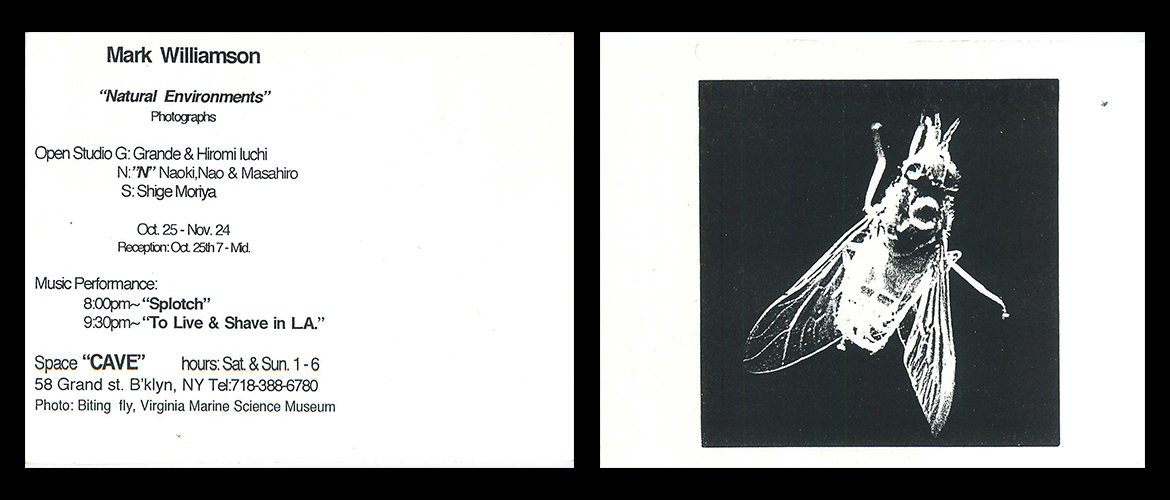
NATURAL ENVIRONMENTS

October 25 – November 24, 1996
Natural Environments
Photographs – Biting fly, Virginia Marine Science Museum
by Mark Williamson

Opening night music performances

Splotch
To Live & Shave in L.A.

Additional Works

Studio G:
Grande & Hiromi Iuchi

Studio N:
N
Paintings by Naoki Iwakawa
Sound by Nao Sakamoto
Film projection by Masahiro Manabe

Studio S:
The Things We Step On -rainbow-
Installation by Shige Moriya

Links


>Exhibition Images

>Video Documentation

About

From 1996-2006, the gallery at CAVE showed the work of over 300 artists becoming a locus for experimentation in all mediums. CAVE Gallery began as a venture of Shige Moriya and a group of artists in the mid-90’s. Fostered from an industrial rental, they transformed the 3,000 sq ft garage into a live-work space, which was considered to be one of the first recognized galleries of the neighborhood. Away from heavy commercial pressure, in an environment that supported exploration, artists were able to present ‘nakedly’ by offering completed and in-progress works and receiving feedback from peers. In addition to studio arts, openings often included music and other kinds of performances.

Exh: 1996/09

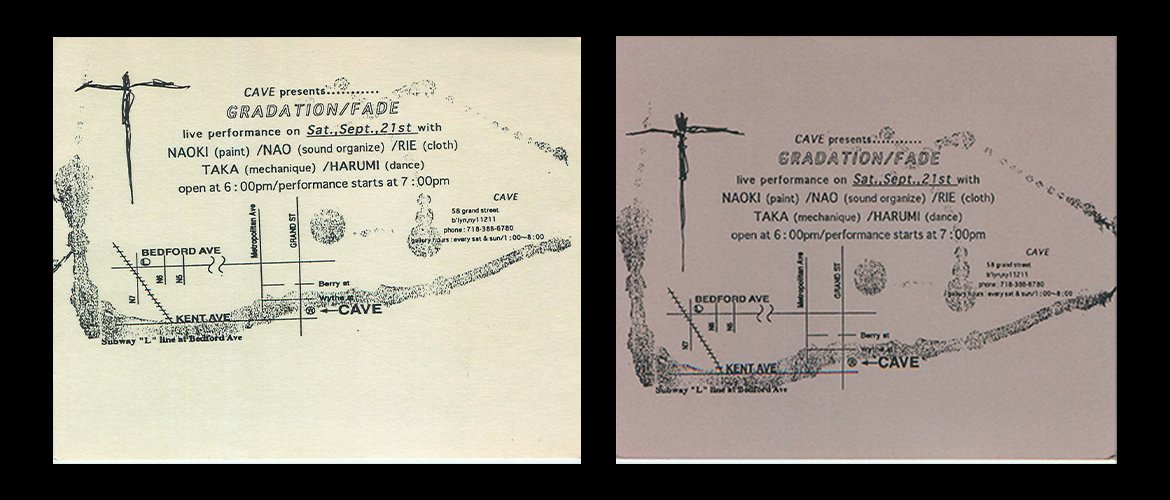
GRADATION/FADE

September 21 – October 20, 1996
Gradation/Fade

Paintings by Naoki Iwakawa

Performance for opening

Action Paintings by Naoki Iwakawa
Sound organized by Nao Sakamoto
Engine Manipulation by Hidetaka Takasaki
Dance by Harumi
Cloth Design by Rie

Additional Works

Studio G:
Grande

Studio N:
Naoki Iwakawa & Rie

Links

About

From 1996-2006, CAVE Gallery showed the work of over 300 artists becoming a locus for experimentation in all mediums. CAVE gallery began as a venture of Shige Moriya and a group of artists in the mid-90’s. Fostered from an industrial rental in Williamsburg, Brooklyn, they transformed the 3,000 sq ft garage into a live-work space, which was considered to be one of the first recognized galleries of the neighborhood. Away from heavy commercial pressure, in an environment that supported exploration, artists were able to share their works and engage in informal conversations with each other. Very quickly, a hangout for artistic types and underground enthusiasts was established.

Exh: 1996/07

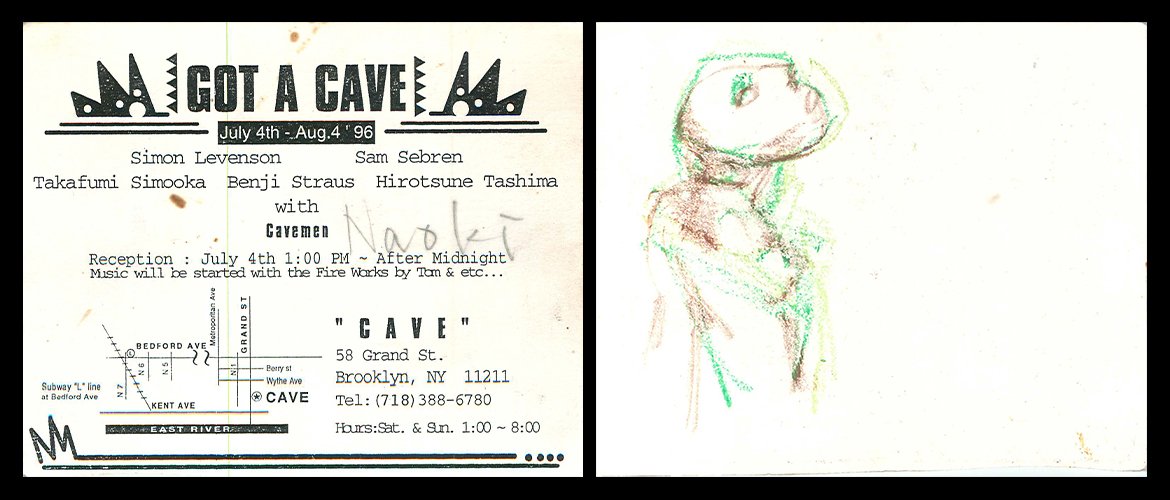
GOT A CAVE

April 4 – May 2, 1998
Empty Vessels
by E. Lynn Hassan

Additional Works

Studio S:
Dear Neighbor…
by Lucile Betrand with Mark Dresser & Minako

Studio G:
Garden
Installation by Grande

Studio N:
N
Installation by Naoki Iwakawa
Sound Organized by Nao Sakamoto

Links


>Exhibition Images

>Video Documentation

About

From 1996-2006, the gallery at CAVE showed the work of over 300 artists becoming a locus for experimentation in all mediums. CAVE Gallery began as a venture of Shige Moriya and a group of artists in the mid-90’s. Fostered from an industrial rental, they transformed the 3,000 sq ft garage into a live-work space, which was considered to be one of the first recognized galleries of the neighborhood. Away from heavy commercial pressure, in an environment that supported exploration, artists were able to present ‘nakedly’ by offering completed and in-progress works and receiving feedback from peers. In addition to studio arts, openings often included music and other kinds of performances.

Hello world!

Welcome to WordPress. This is your first post. Edit or delete it, then start writing!

Frantic Beauty

“Frantic Beauty”, Process Art Book, LEIMAY Ensemble, ed. Maddie Winchester

borders

“borders”, Process Art Book with Lucy Kerr, Hiram Pines, Ximena & Shige

truba

Triumphant Trumpet

A trumpet is a musical instrument. It is the highest register in the brass family. Trumpets are among the oldest musical instruments,[1] dating back to at least 1500 BC. They are played by blowing air through closed lips, producing a “buzzing” sound that starts a standing wave vibration in the air column inside the instrument. Since the late 15th century they have primarily been constructed of brass tubing, usually bent twice into a rounded oblong shape.

There are several types of trumpet. The most common is a transposing instrument pitched in B♭ with a tubing length of about 148 cm. Earlier trumpets did not have valves, but modern instruments generally have either three piston valves or, more rarely, three rotary valves. Each valve increases the length of tubing when engaged, thereby lowering the pitch.

A musician who plays the trumpet is called a trumpet player or trumpeter.

onion

Vegan Foodie Paradise

Veganism /ˈviːɡənɪzəm/ is the practice of abstaining from the use of animal products, particularly in diet, as well as following an associated philosophy that rejects the commodity status of sentient animals. A follower of veganism is known as a vegan.

Distinctions are sometimes made between different categories of veganism. Dietary vegans (or strict vegetarians) refrain from consuming animal products, not only meat but, in contrast to ovo-lacto vegetarians, also eggs, dairy products and other animal-derived substances. The term ethical vegan is often applied to those who not only follow a vegan diet, but extend the vegan philosophy into other areas of their lives, and oppose the use of animals or animal products for any purpose.[4] Another term used is environmental veganism, which refers to the avoidance of animal products on the premise that the harvesting or industrial farming of animals is environmentally damaging and unsustainable.

The term vegan was coined in 1944 by Donald Watson when he co-founded The Vegan Society in England, at first to mean “non-dairy vegetarian” and later to refer to “the doctrine that man should live without exploiting animals.”Interest in veganism increased in the 2000s; vegan food became increasingly available in supermarkets and restaurants in many countries, and several top athletes in endurance sports, such as the Ironman triathlon and the ultramarathon, began to practise veganism and raw veganism.

A 2009 research review indicated that vegan diets tend to be higher in dietary fibre, magnesium, folic acid, vitamin C, vitamin E, iron and phytochemicals, and lower in calories, saturated fat, cholesterol, long-chain omega-3 fatty acids, vitamin D, calcium, zinc and vitamin B12.[8] Well-planned vegan diets appear to offer protection against certain degenerative conditions, including heart disease,[9] and are regarded as appropriate for all stages of the life-cycle by the American Dietetic Association, the Australian National Health and Medical Research Council, and Dietitians of Canada.[10] Because uncontaminated plant foods do not provide vitamin B12 (which is produced by microorganisms such as bacteria), researchers agree that vegans should eat B12-fortified foods or take a supplement.
Lemon-Vodka Life Philosophy

I believe that if life gives you lemons, you should make lemonade… And try to find somebody whose life has given them vodka, and have a party.” 

Ron White

  • gradient
  • gradient

Indie Music Production

The term indie rock, which comes from “independent,” describes the small and relatively low-budget labels on which it is released and the do-it-yourself attitude of the bands and artists involved. Although distribution deals are often struck with major corporate companies, these labels and the bands they host have attempted to retain their autonomy, leaving them free to explore sounds, emotions and subjects of limited appeal to large, mainstream audiences. The influences and styles of the artists have been extremely diverse, including punk, psychedelia, rock and country. The terms “alternative rock” and “indie rock” were used interchangeably in the 1980s, but after many alternative bands followed Nirvana into the mainstream in the early 1990s, “indie rock” began to be used to describe those bands, working in a variety of styles, that did not pursue or achieve commercial success.

Allmusic identifies indie rock as including a number of “varying musical approaches [not] compatible with mainstream tastes”. Linked by an ethos more than a musical approach, the indie rock movement encompassed a wide range of styles, from hard-edged, grunge-influenced bands, through do-it-yourself experimental bands like Pavement, to punk-folk singers such as Ani DiFranco.Many countries have developed an extensive local indie scene, flourishing with bands with enough popularity to survive inside the respective country, but virtually unknown elsewhere.

Indie rock has been identified as a reaction against the macho culture that developed in alternative rock in the aftermath of Nirvana’s success. Indie rock is noted for having a relatively high proportion of female artists compared with preceding rock genres, a tendency exemplified by the development of the feminist-informed Riot Grrrl music of acts like Bikini Kill, Bratmobile, 7 Year Bitch, Team Dresch and Huggy Bear.

  • cupi
  • modohome

Honey Road

Honey /ˈhʌni/ is a sweet food made by bees using nectar from flowers. The variety produced by honey bees (the genus Apis) is the one most commonly referred to, as it is the type of honey collected by most beekeepers and consumed by people. Honeys produced by other bees (bumblebees, stingless bees) and other hymenoptera insects (e. g. honey wasps) have different properties, and they are not discussed in this article.Honey bees transform nectar into honey by a process of regurgitation and evaporation. They store it as a primary food source in wax honeycombs inside the beehive.Honey gets its sweetness from the monosaccharides fructose and glucose, and has approximately the same relative sweetness as granulated sugar.[1][2] It has attractive chemical properties for baking and a distinctive flavor that leads some people to prefer it over sugar and other sweeteners.[1] Most microorganisms do not grow in honey because of its low water activity of 0.6.  However, honey sometimes contains dormant endospores of the bacterium Clostridium botulinum, which can be dangerous to infants, as the endospores can transform into toxin-producing bacteria in infants’ immature intestinal tracts, leading to illness and even death.

Honey has had a long history in human consumption, and is used in various foods and beverages as a sweetener and flavoring. It also has a role in religion and symbolism. Flavors of honey vary based on the nectar source, and various types and grades of honey are available. It has also been used in various medicinal traditions to treat ailments. The study of pollens and spores in raw honey (melissopalynology) can determine floral sources of honey.[5] Bees carry an electrostatic charge whereby they attract other particles in addition to pollen, which become incorporated into their honey; the honey can be analysed by the techniques of melissopalynology in area environmental studies of radioactive particles, dust and particulate pollution.

  • cupi
  • modohome

Honey Road

Honey /ˈhʌni/ is a sweet food made by bees using nectar from flowers. The variety produced by honey bees (the genus Apis) is the one most commonly referred to, as it is the type of honey collected by most beekeepers and consumed by people. Honeys produced by other bees (bumblebees, stingless bees) and other hymenoptera insects (e. g. honey wasps) have different properties, and they are not discussed in this article.Honey bees transform nectar into honey by a process of regurgitation and evaporation. They store it as a primary food source in wax honeycombs inside the beehive.Honey gets its sweetness from the monosaccharides fructose and glucose, and has approximately the same relative sweetness as granulated sugar.[1][2] It has attractive chemical properties for baking and a distinctive flavor that leads some people to prefer it over sugar and other sweeteners.[1] Most microorganisms do not grow in honey because of its low water activity of 0.6.  However, honey sometimes contains dormant endospores of the bacterium Clostridium botulinum, which can be dangerous to infants, as the endospores can transform into toxin-producing bacteria in infants’ immature intestinal tracts, leading to illness and even death.

Honey has had a long history in human consumption, and is used in various foods and beverages as a sweetener and flavoring. It also has a role in religion and symbolism. Flavors of honey vary based on the nectar source, and various types and grades of honey are available. It has also been used in various medicinal traditions to treat ailments. The study of pollens and spores in raw honey (melissopalynology) can determine floral sources of honey.[5] Bees carry an electrostatic charge whereby they attract other particles in addition to pollen, which become incorporated into their honey; the honey can be analysed by the techniques of melissopalynology in area environmental studies of radioactive particles, dust and particulate pollution.

thank-you

New Wave Of Comedy

Many comics achieve a cult following while touring famous comedy hubs such as the Just for Laughs festival in Montreal, the Edinburgh Fringe, and Melbourne Comedy Festival in Australia. Often a comic’s career advances significantly when they win a notable comedy award, such as the Edinburgh Comedy Award (formerly the Perrier comedy award). Comics sometimes foray into other areas of entertainment, such as film and television, where they become more widely known; e.g., Eddie Izzard or Charlyne Yi. However, a comic’s stand-up success does not guarantee a film’s critical or box office success.

thank-you

New Wave Of Comedy

Many comics achieve a cult following while touring famous comedy hubs such as the Just for Laughs festival in Montreal, the Edinburgh Fringe, and Melbourne Comedy Festival in Australia. Often a comic’s career advances significantly when they win a notable comedy award, such as the Edinburgh Comedy Award (formerly the Perrier comedy award). Comics sometimes foray into other areas of entertainment, such as film and television, where they become more widely known; e.g., Eddie Izzard or Charlyne Yi. However, a comic’s stand-up success does not guarantee a film’s critical or box office success.

100H

Magnoliophyta

A flower, sometimes known as a bloom or blossom, is the reproductive structure found in flowering plants (plants of the division Magnoliophyta, also called angiosperms). The biological function of a flower is to effect reproduction, usually by providing a mechanism for the union of sperm with eggs. Flowers may facilitate outcrossing (fusion of sperm and eggs from different individuals in a population) or allow selfing (fusion of sperm and egg from the same flower). Some flowers produce diaspores without fertilization (parthenocarpy). Flowers contain sporangia and are the site where gametophytes develop. Flowers give rise to fruit and seeds. Many flowers have evolved to be attractive to animals, so as to cause them to be vectors for the transfer of pollen.

zena

Clubbing As Subculture

Roots of clubbing are in disco wave in 1970s, but developing begun in 1980s with evolution of DJ-ing and raves. The subculture took shape in the late 1980s and early 1990s at underground rave parties in the U.S. and London (Reynolds 1998). Numerous social changes have, however, occurred since then to transform this subculture into a mainstream movement, youth-oriented lifestyle and global activity (see Bennett 2001, Reynolds 1998; Hill 2002).From the beginning, clubbing, while it was more rave subculture, has involved mostly younger people between 16 and 25 years of age. A subculture emerged around raves, featuring an ethos of peace, love, unity, and respect (the PLUR doctrine), rooted in community and empathy for others (Hill 2002; Hutson 2000; Reynolds 1998). Today, however, Tammy L. Anderson says, the rave scene has given way to a more nightclub-based electronic dance music (EDM) scene featuring an older (18– 35 years of age) crowd which very much involves the consumption of alcohol.

Becoming-Corpus

“Becoming-Corpus”, Process Art Book by Angeli Sion & Ximena Garnica

CAVE, Butoh & NY

“CAVE, Butoh & NY”, View Points, The Saison Foundation, Japan

New York Art Scene

“New York Art Scene”, Art/Criticism (Vol.1), Tohshin-do co., Japan

1 7 8 9 10